
Which Is Better—Rote Learning or Inquiry-Based Learning?

Updated: Sep 3
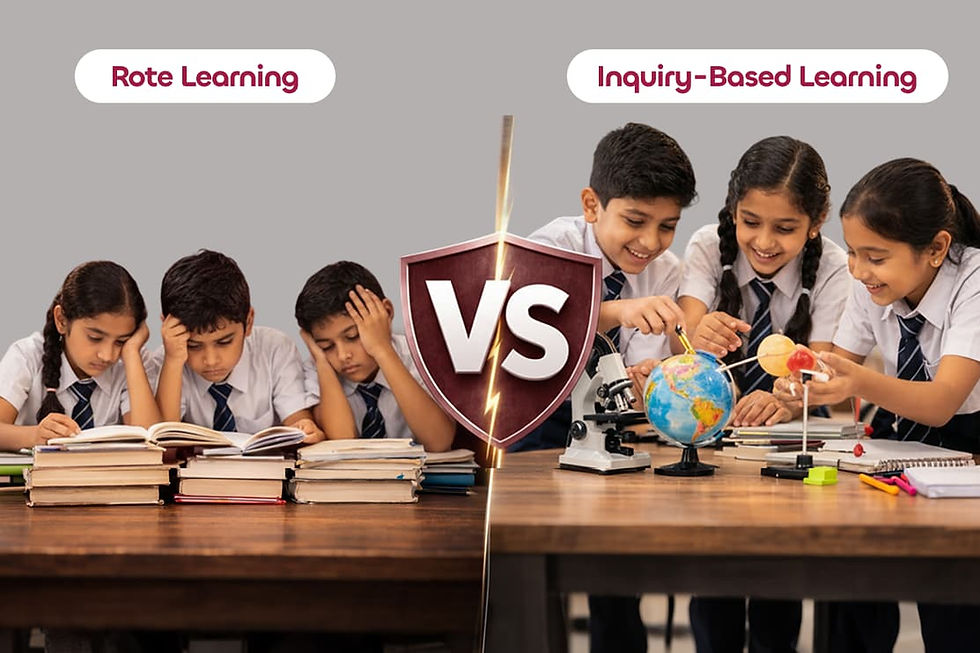
Inquiry-based learning is generally better for developing deep understanding, critical thinking and the ability to apply knowledge, while rote learning is useful for memorising essential facts. In rote learning, children repeat information until they can recall it accurately. In inquiry-based learning, they ask questions, investigate ideas, examine evidence and solve problems.
Rote practice can help children master multiplication tables, spellings, formulas and key facts, but it should not be the only teaching method. The strongest syllabus combines both approaches: students first build strong foundational knowledge and then apply it through experiments, discussions, projects and real-world problem-solving. This balanced approach supports conceptual clarity, academic fluency, long-term retention and independent thinking.
What Is Rote Learning
Rote learning is memorisation through repetition—you hear it, you repeat it, you store it. Think multiplication tables, the periodic table, spellings, or historical dates.
It deserves more respect than the modern backlash gives it. Rote learning builds a child's mental library: the fast, automatic recall that frees up working memory for harder tasks. A child who has not memorised number bonds will struggle with multi-step word problems, because their brain is busy computing basics instead of reasoning.
The problem starts when a syllabus relies on rote alone. It tends to produce linear thinking—students become excellent at retrieving stored answers but stall when a question is framed in a way the textbook never showed them. It quietly trains a mindset of compliance: find the one "right" answer, rather than explore whether several answers might be valid. Strong on recall, fragile under pressure from anything unfamiliar.
Related Article: Pre-School vs. Home-schooling
What Is Inquiry-Based Learning?
Inquiry-based learning flips the sequence. Instead of starting with an answer to memorise, it starts with a question, a problem, or a scenario—and the student investigates their way to understanding.
A useful contrast comes from STEM teaching. In a rote model, students are told the parts of a cell and memorise them. In an inquiry model, students examine cells under a microscope and design a small experiment to answer "How do plant and animal cells differ?" The end product isn't just a labelled diagram—it's the ability to observe, hypothesise, and analyse evidence.
Decades of cognitive research support why this sticks. Educational theory from Bloom's taxonomy onward shows that learners build higher-order skills—applying, analysing, evaluating, creating—on top of foundational knowledge, not instead of it. Global assessments such as PISA have repeatedly flagged that memorisation-heavy systems underperform on real-world problem-solving, which is precisely why NEP 2020 leaned on competency-based learning. IBL nurtures curiosity, ownership, and what psychologists call a growth mindset—where a failed experiment is treated as a data point, not a personal verdict.
Difference Between Rote Learning and Inquiry-Based Learning
Feature | Rote Learning | Inquiry-Based Learning |
Focus | Memorization | Understanding |
Classroom | Teacher-led | Student-led |
Thinking | Recall | Critical Thinking |
Creativity | Low | High |
Problem Solving | Limited | Excellent |
This table is the part most parents should screenshot. Neither column is "wrong." The danger is living entirely in one of them.
Related Article: Best AI Tools for Students in 2026
Core Differences Between Rote Learning and Inquiry-Based Learning
Learning approach: Rote learning focuses on repetition and memorisation, while inquiry-based learning encourages students to ask questions, investigate ideas and discover answers.
Role of the student: In rote learning, students mainly receive and recall information. In inquiry-based learning, students actively participate in discussions, experiments, projects and problem-solving activities.
Role of the teacher: Rote learning is generally teacher-led, with information delivered directly to students. Inquiry-based learning positions the teacher as a facilitator who guides exploration and encourages independent thinking.
Understanding of concepts: Rote learning helps students remember facts, formulas, definitions and procedures. Inquiry-based learning helps them understand why concepts work and how they can be applied.
Classroom activities: Rote learning commonly involves repetition, note-taking, worksheets and practice tests. Inquiry-based classrooms use research, group discussions, observations, experiments and real-world challenges.
Assessment style: Rote learning is often assessed through recall-based questions and standardised tests. Inquiry-based learning may be assessed through presentations, projects, practical tasks, explanations and application-based questions.
Knowledge retention: Memorised information may be forgotten when it is not regularly revised. Knowledge developed through investigation and application is often retained for longer.
Skill development: Rote learning strengthens memory, speed and accuracy. Inquiry-based learning develops critical thinking, creativity, communication, collaboration and decision-making.
Main Benefits of Rote Learning
Helps students memorise multiplication tables, spellings, formulas, vocabulary and important facts.
Builds speed and accuracy in tasks that require immediate recall.
Provides a strong foundation before students move to more complex concepts.
Supports structured revision and preparation for recall-based assessments.
Can improve confidence when students need to use basic information quickly.
Works effectively when combined with explanation, practice and practical application.
Main Benefits of Inquiry-Based Learning
Encourages children to become curious and ask meaningful questions.
Develops deeper conceptual understanding instead of surface-level memorisation.
Strengthens critical thinking, reasoning and problem-solving abilities.
Helps students connect classroom lessons with real-life situations.
Encourages independent learning and responsible decision-making.
Improves communication and collaboration through group activities and discussions.
Allows students to explore different solutions rather than depend on one fixed answer.
Supports creativity, experimentation and innovation.
Makes learning more engaging, interactive and personally meaningful.
Prepares students for competency-based assessments, higher education and future careers.
Which Approach Should Schools Use?
Schools should not treat rote learning and inquiry-based learning as complete opposites. Children need foundational knowledge, but they must also understand how to use that knowledge.
For example, a student may memorise a mathematical formula through repetition. However, inquiry-based activities help the student understand why the formula works, when to use it and how it can solve a practical problem.
The most effective learning environment therefore combines:
Memorisation for essential facts and academic fluency.
Explanation for strong conceptual understanding.
Practice for accuracy and confidence.
Inquiry for exploration and independent thinking.
Application for solving real-world problems.
This balanced approach helps children become academically capable, curious, adaptable and confident learners.
The Science of Retention: Cognitive Load and Deep Encoding
The clearest difference between the two methods is what happens after the exam.
Rote learning leans hard on short-term memory. A student can cram, score brilliantly, and then lose most of the material within weeks—because the information was never anchored to anything meaningful. It was stored, not understood.
Inquiry-based learning works through deep encoding. When a child connects a new idea to prior knowledge through a debate, a hands-on experiment, or a real problem, the brain files it with multiple retrieval hooks. That's why the IBL student often outperforms the crammer on application-based questions months later: they didn't memorise the answer, they understood the mechanism that produces it.
The Teacher's Role: Sage on the Stage vs. Guide on the Side
The syllabus quietly dictates the teacher's role—and the teacher's role shapes your child's autonomy.
In a rote-heavy classroom, the teacher is the single source of truth, and students wait to be told what matters. It's efficient for delivering content to forty children at once, but it breeds intellectual passivity.
In an inquiry classroom, the teacher becomes a facilitator who frames good questions and lets students wrestle with them. This hands the locus of control to the child. And when children feel ownership over their learning, intrinsic motivation rises sharply—they study to satisfy curiosity, not just to clear a test. That single shift, sustained over years, is what separates a confident independent learner from an anxious exam-taker.
Preparing Your Child for a Job Market That Doesn't Exist Yet
Here's the uncomfortable truth about a purely rote education in 2026: machines already do rote better than any human ever will. Data retrieval, calculation, and recall are precisely what automation and AI have made cheap and instant.
What remains stubbornly human—and increasingly valuable—is empathy, complex problem-solving, and the ability to connect ideas across disciplines. These are exactly the muscles inquiry-based learning develops. A syllabus built on memorisation alone risks producing graduates who are, as educators put it, over-educated but under-skilled. A syllabus that teaches children to question prepares them for careers that haven't been invented yet.
The Smartest Answer Isn't Either/Or — It's a Hybrid Model
The most damaging mistake in this debate is treating it as a contest with one winner. The strongest schools don't pick a side; they sequence the two intelligently.
You cannot run a meaningful inquiry into climate change if a child hasn't first internalised the basic water cycle. You cannot do creative algebra without fluent number facts. The best curricula identify which content demands foundational memorisation (the tools) and which demands investigative depth (the vision)—and they layer inquiry on top of solid basics, never instead of them.
In practice, that looks like a child who memorises the periodic table and designs an experiment to test reactivity. Who learns historical dates and analyses what economic pressures caused those events. Facts give speed; inquiry gives meaning. A child needs both to thrive in a system that now rewards both.
What This Means When Choosing a School in Hyderabad
When you tour a school, look past the marketing and watch the classroom. Are students filling repetitive worksheets, or working on projects and asking "why"? Is homework about reproducing notes, or applying ideas? Does the school talk about NEP 2020 and competency-based learning as a lived practice, or just a line on the website?
At Celeste School in Boduppal, the goal is exactly this balance—pairing strong academic foundations with genuine inquiry, so students aren't walking encyclopedias but confident problem-solvers ready for modern boards, competitive exams, and the world beyond. The aim is simple: children who are not just exam-ready, but life-ready.
Want to see how inquiry-led learning works in a real classroom? Book a campus visit at Celeste School, Boduppal — and watch your child's curiosity in action before you decide.


Comments